
BF.Marktradar Oktober 2026
Sentiment Among Lenders Stabilizes Despite Rising Interest Rates
According to the latest BF.Quartalsbarometer, real estate financiers are reporting an increase in new business, despite a significant rise in medium and long-term capital market interest rates in September. At the same time, the European Central Bank’s recent rate hike and ongoing geopolitical uncertainty are making financing calculations more challenging. Nevertheless, in our view, further market recovery remains possible. However, this will require real estate investments to remain economically viable under the current financing environment.

New Business Gains Momentum, While Lending Conditions Remain Challenging
The latest BF.Quartalsbarometer shows a noticeable improvement. In the third quarter of 2026, the index rose by 13.67 points to -12.3. While sentiment remains in negative territory, it has improved significantly compared to the previous quarter. Notably, the barometer increased despite the ongoing conflict in Iran.
Thirty-five percent of respondents reported an increase in new business, while the remaining 65 percent saw stable activity. No participant reported a decline. In the previous quarter, nearly one-quarter of respondents had experienced decreasing volumes of new business.
Financing conditions have also stabilized according to the vast majority of respondents, with 80 percent seeing no meaningful change compared to the previous quarter. Margins and loan-to-value ratios have remained largely unchanged on average. Consistent with this trend, risk mitigation continues to be a key priority in new lending activity, cited by 80 percent of respondents.
New Investments Require Sustainable Business Cases
The recovery in new business demonstrates that investments remain possible under current market conditions. However, this should not be mistaken for a return to overly optimistic assumptions. The critical factor is whether purchase prices, investment costs, and achievable income are once again aligned.
This relationship is often underestimated, particularly in residential development. Housing in growing regions remains attractive due to sustained demand, but housing shortages alone do not make a development project profitable. What ultimately matters is whether long-term rental income at a given location can cover total project costs, including an appropriate return on capital.
A further bottleneck remains equity capital. This is reflected in the increased demand observed in the Quarterly Barometer for equity-like financing structures and equity contributions from joint venture partners. However, additional equity cannot compensate for insufficient project profitability. New equity providers also require adequate returns. Where these cannot be achieved, project costs, acquisition prices, or the project concept itself must be adjusted.
Zinsentwicklung
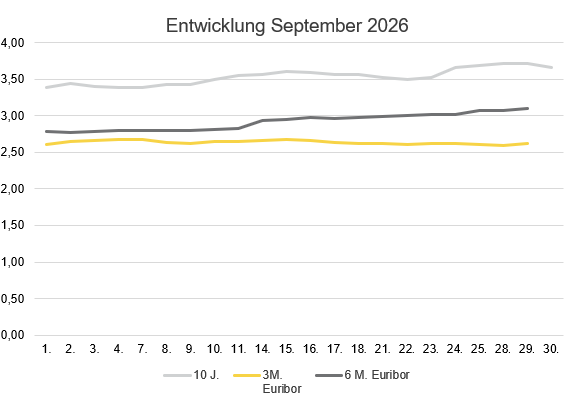
Interest rates developed differently across maturities in September. On 29 September, the three-month Euribor stood at 2.617 percent, almost unchanged from 2.608 percent at the beginning of the month. In contrast, the six-month Euribor increased from 2.779 percent to 3.103 percent.
The rise in ten-year swap rates was particularly pronounced, increasing from 3.39 percent to 3.71 percent, equivalent to a rise of 32 basis points. A temporary easing observed during the second half of the month did not persist.
As a result, the capital market basis for new fixed-rate financing and hedging transactions has become more expensive. Even unchanged lending margins cannot offset the resulting increase in overall financing costs. Previously, 75 percent of respondents in the BF Quarterly Barometer had expected higher interest rates for ten-year financings by year-end. Developments in September have so far confirmed that expectation.
While the September figures illustrate the rise in nominal interest rates, they do not reveal the relative contributions of real rates, inflation expectations, or risk premiums. Nevertheless, we continue to expect real interest rates to remain structurally higher over the long term. Even if inflation declines, interest rates are unlikely to return to the levels seen before the Iran conflict.
Outlook
Recent developments provide grounds for cautious optimism. New business activity is recovering, and financing conditions have stabilized according to most respondents. At the same time, higher capital market rates are increasing the cost of both new financings and refinancing transactions. The emerging recovery must therefore prove itself under persistently challenging conditions.
For investors and developers, this means that project viability cannot depend on the expectation of imminent interest rate relief. Sustainable business plans require reliable income assumptions, realistic investment costs, and sufficient reserves for delays or cost overruns.
For existing financings, future debt service obligations and potential equity requirements should be clarified at an early stage. As a rule of thumb, at least 18 months should be allowed for this process.
Financeable projects and new transactions remain achievable even in the current environment, as evidenced by the improvement in new business activity. However, a broader market recovery will require more property owners to adjust their price expectations to today’s market realities.