
BF.Marktradar November 2026
The ECB’s Interest Rate Pause Will Not Resolve Financing Challenges
The European Central Bank (ECB) left its key interest rates unchanged at the end of October. However, this should not raise expectations of a broad-based easing of financing conditions. Above all, the rate pause should not encourage market participants to postpone necessary price adjustments any further. For the real estate industry, the decisive factor is not the ECB’s policy rates but long-term borrowing costs, whose previous increase was only partially reversed in October. In addition to inflation risks, rising government debt is putting pressure on capital markets.

Inflation and Government Debt Increase Upward Pressure on Interest Rates
A key driver of the rise in interest rates in recent months has been the renewed increase in inflationary pressure caused by higher energy prices in the wake of the war in Iran. However, the decisive factor for long-term interest rates is not so much the current inflation rate as the question of how persistent this price pressure will be.
A further factor is the growing level of government debt across almost all advanced Western economies. The International Monetary Fund (IMF) identifies high debt levels, persistent spending pressures and the substantial volume of expected government bond issuance as major challenges for long-term bond markets. Not every increase in bond yields necessarily reflects declining confidence in a country’s creditworthiness. The additional government bonds simply need to be absorbed by investors. If investor demand does not increase accordingly, higher yields will be required to attract sufficient capital.
In an article published by Handelsblatt, economist Clemens Fuest warns that supporting highly indebted countries could ultimately take precedence over a consistent commitment to fighting inflation. High levels of government debt could also lead to further compulsory government measures, such as requiring banks and insurance companies to increase their holdings of sovereign bonds. Fuest considers such a development highly likely, even if it may currently seem difficult to imagine.
Returning to the present, the ECB’s independence has not, at least so far, been challenged by any European government. Likewise, the US Federal Reserve System has thus far withstood considerable political pressure. The question is how long, and to what extent, central banks will be able to maintain their independence. What is clear is that pressure will increase as government debt continues to rise.
Higher Borrowing Costs Constrain Property Prices and New Development
What do higher interest rates mean for the real estate industry? Property developments are being squeezed on both sides of their financial calculations. Construction financing remains expensive, while prospective buyers have only limited capacity to finance purchase prices. In transactions involving institutional investors, higher required investment yields also reduce the prices achievable on disposal. Strong housing demand alone cannot close this viability gap. Despite the housing shortage, household affordability ultimately limits the scope for rent increases.
For existing properties, the situation becomes particularly challenging when higher debt servicing costs coincide with lower mortgage lending values. In such cases, additional equity contributions may become necessary even if rental income remains stable. Extending the maturity of a loan can buy time, but it will only resolve the underlying problem if that time is used to increase income, reduce leverage or establish a sustainable refinancing structure. We therefore expect that some upcoming refinancings will require asset disposals and price concessions.
Interest Rate Developments
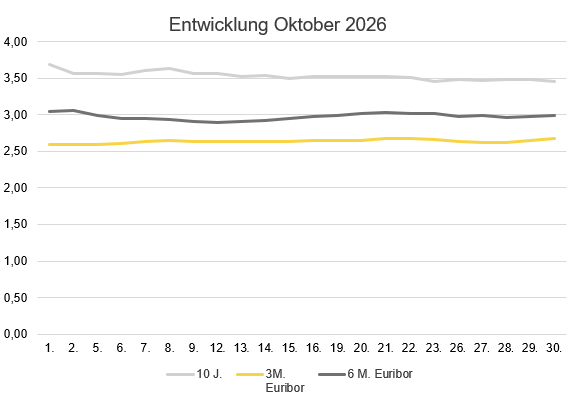
In October, long-term swap rates eased somewhat following their significant increase in September. The 10-year euro interest rate swap declined from 3.69% on 1 October to 3.46% on 29 October. Nevertheless, it remained above its level of 3.39% on 1 September. The easing in October therefore only partially reversed the increase recorded in September.
Developments at the short end of the yield curve were mixed. Three-month Euribor rose from 2.59% to 2.68% in October, while six-month Euribor declined from 3.04% to 2.99%. As a result, the underlying capital market rates for new fixed-rate financing and interest rate hedging improved over the course of the month.
Interest Rate Developments
At its meeting on 29 October, the ECB left its key interest rates unchanged, with the deposit facility rate remaining at 2.50%. The decision is understandable: Higher interest rates cannot eliminate the energy price shock, while tighter financing conditions are already dampening demand. The decisive question is whether price pressures will increasingly feed through into wages and other prices. So far, the ECB has not observed a significant wage response. The rate pause therefore signals neither an all-clear nor a commitment to imminent rate cuts.
The easing in capital market interest rates in October is welcome. However, sustained relief would require inflation risks to recede and fiscal policy to restore confidence in the sustainability of public finances. As long as uncertainty persists on both fronts, long-term borrowing costs are likely to remain subject to significant volatility, even if policy rates remain unchanged.
For the real estate industry, the key priority is therefore to ensure that investments and refinancing arrangements are financially viable under current market conditions. Neither the expectation that inflation will erode the real value of debt nor hopes of politically suppressed interest rates provide a reliable basis for financing decisions.
In our view, many real estate assets still require further downward price adjustments. Numerous market participants have already postponed and delayed these necessary corrections for far too long. They should not be deferred any further on the basis of overly optimistic expectations that the current easing in interest rates and capital market conditions will prove lasting.