
September 2026
Lenders Caught Between New Business and Dealing with Legacy Issues
The latest vdp figures point to an increase in new real estate lending. Helaba’s example shows that lenders can manage both at the same time: work through the burdens accumulated over recent years while continuing to originate new business. From a monetary policy perspective, another ECB rate hike in September appears highly likely. Whether this will actually be followed by the series of further rate increases currently priced in by the markets is far less certain.

At first glance, the latest figures from the Association of German Pfandbrief Banks (vdp) paint a positive picture. In the first half of 2026, its member institutions originated EUR 80.4 billion in new real estate loans, 8.5% more than in the same period of the previous year. Growth in commercial real estate financing was particularly strong at 14.3%. It is also noteworthy that new lending for office properties increased by 9.6%. However, one important caveat remains: all of these figures are still coming from a low base by historical standards. They do not yet indicate the start of a new upswing. Overall, the volume of commercial real estate loans declined by 3.5% because new lending was not sufficient to offset repayments.
The latest Helaba figures for the first half of 2026 illustrate just how contradictory the current situation is. The Group’s net profit more than halved. Its real estate segment even recorded a pre-tax loss of EUR 26 million. By comparison, the segment had generated a profit of EUR 106 million in the previous year. Loan-loss provisions rose from EUR 26 million to EUR 113 million. At the same time, however, medium- and long-term new business in the real estate segment increased from EUR 3.0 billion to EUR 3.9 billion.
The example should not be generalised, but it illustrates an important pattern: banks still have to work through burdens from their real estate portfolios while at the same time remaining willing to originate new business. The problems stemming from the previous cycle and the financing of new transactions are running in parallel.
Interest Rate Development
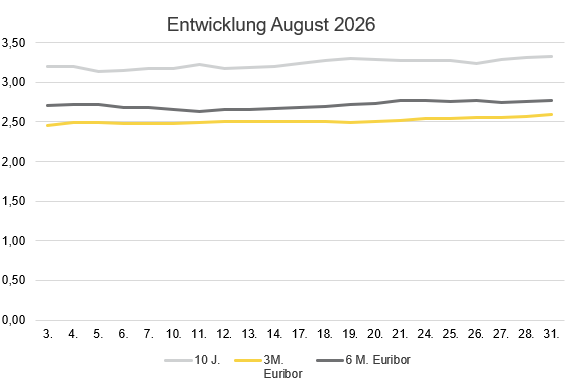
Both short- and long-term interest rates rose again in August. Three-month Euribor increased from 2.46% at the beginning of the month to 2.59% at the end of the month. Six-month Euribor rose from 2.71% to 2.77% over the same period.
Rates also continued to rise at the long end of the curve. The 10-year swap rate stood at 3.20% at the beginning of August and ended the month at 3.32%. This means that the temporary easing seen following the ceasefire in the Iran conflict has now been completely reversed.
The trend in eurozone policy rates is also pointing upwards. Ahead of the ECB’s next meeting on 10 September, there is currently much to suggest another 25-basis-point increase in the deposit facility rate. Eurozone inflation rose to 3.3% in August. A recent Reuters poll of 65 economists also found unanimous expectations that the deposit rate will be raised to 2.5%. However, the majority also expect this to be the final rate increase for the time being.
This assessment is consistent with the ECB’s own view, as reflected in the minutes of its most recent meeting. In July, the Governing Council continued to see considerable risks stemming from high energy prices. At the same time, indications of indirect and second-round effects remained comparatively reassuring. It is also noteworthy that the ECB does not attribute the rise in long-term interest rates solely to higher inflation expectations. Alongside the inflation component, real interest rates also play an important role – and these have risen as well. This means that interest rates will not simply fall again once inflation declines. The cost of capital itself has also increased.
Unlike the Reuters poll cited above, Handelsblatt expects interest rates to remain higher over the medium term as well. According to the newspaper’s analysis, markets are not only pricing in a rate increase in September but also a deposit facility rate of at least 3.0% by mid-2027. Several economists, however, consider these expectations excessive. Their argument is plausible: the current surge in inflation is still largely driven by energy prices and therefore by a supply shock. Yet the ECB itself can do little to address high energy prices.
In our view, it is therefore important to distinguish between the next rate move and the subsequent interest-rate path. Given an inflation rate of 3.3%, an increase in September would be well justified. However, a rapid succession of further rate hikes would require evidence that the energy price shock is actually spilling over into wages and other prices. So far, there are no clear indications that this is happening.
Outlook
Developments in the real estate financing market are better than current sentiment might suggest. New business is growing again, while at the same time the vdp’s property price data and the Helaba example show that the consequences of the crisis are far from having been fully worked through. Conditions remain particularly challenging in commercial real estate.
Interest-rate developments are therefore likely to remain the decisive factor in the coming months. If the ECB raises rates in September but subsequently adopts a wait-and-see approach, long-term rates could stabilise. If, by contrast, the inflationary surge becomes more entrenched, financing costs will continue to rise. Borrowers should therefore continue to prepare refinancing well in advance rather than relying on interest rates falling significantly again in the short term. Even at their current level, interest rates remain low by long-term historical standards.