
August 2026
While Central Banks Remain on the Fence, Long-Term Rates Keep Going Up
The ECB, the Fed and the Bank of England have not touched their prime rates lately. However, there is reason to anticipate further interest hikes by the central banks before the end of the year. Capital markets have already factored in their elevated inflation expectations. In the years ahead, fiscal policy measures may also have a greater impact on long-term lending rates. Germany, for one, will have to consolidate its budget.

Monetary Policy: Further Interest Rate Hikes Remain Likely
The European Central Bank left its key lending rates unchanged throughout July. Its deposit rate has therefore stayed at 2.25 percent, having been raised by 25 basis points in June. Reasons the ECB cited for its wait-and-see stance include the high degree of uncertainty and the fact that the impact of the energy price shock on inflation are not fully understood yet. Accordingly, the decision is anything but an all-clear signal, for it means merely that the ECB is waiting for further information before making its next move.
In June, the eurozone inflation rate had dropped from 3.2 to 2.8 percent. But it was already back up at 2.9 percent by the end of July. Striking to note is the hefty surge in energy prices by ten percent over the same month the previous year. Even in Germany, the inflation rate went up, rising by 2.3 percent in June and by an estimated 2.8 percent in July. So, it appears that the dip in June was not an actual trend reversal. The inflation rate, in any case, is nowhere near the ECB’s target mark of 2.0 percent.
Three Leading Central Banks Face a Similar Situation
With all of that in mind, markets are bracing themselves for further interest hikes. Following the decision in July, money markets assumed that the ECB would tighten its key lending rates by a total of 50 basis points before the start 2027, with the cycle conceivably starting as early as autumn. Analogously, the majority of economists polled by Reuters expect to see another rate increase in September, prior to the ECB’s next monetary policy meeting. Whether or not this will come to pass depends on the development of energy prices and the next inflation report above all.
Across the Atlantic, the Fed has responded in a similar fashion. It left its prime rates in place for the time being. However, it did not refrain from taking action because it dismissed current US inflation as a non-issue. In fact, three members of the Open Market Committee already voted in favour of a rate increase. Considering that the Fed is under massive political pressure to cut interest rates, its decision to hold them steady can be interpreted as a modest signal for the bank’s autonomy. That being said, interest rates are expected to rise as the year progresses: Market anticipation of a rate increase in September currently exceeds a 50-percent probability.
The monetary policy of the United Kingdom presents a comparable picture: The Bank of England held its base rate unchanged at 3.75 percent. But given a vote of six to three, the decision was closer than had been expected. Indeed, three members already voted in favour of tightening rates. While markets anticipate another interest rate move before the end of the year, the respondent economists were more cautious in their outlook.
Central Banks, While Hesitant, Do Not Rule out Future Interest Hikes
Conclusion: The top three central banks maintain their wait-and-see attitude even though they are under different degrees of inflationary pressure. However, they are united in their explicit or implicit refusal to rule out further increases. By contrast, the long-term capital market rates have already begun to respond to inflation rate and prime rate developments they expect to see in the coming months – and it appears that market players are predominantly anticipating higher inflation rates.
From our point of view, the current rise in interest rates does not suggest doubts in the Germany’s credit worthiness. Despite higher borrowings, the country’s public debt will still be at 66.5 percent by the end of 2026, and therefore well below the average debt-to-GDP ratio within the Euro Group. Nevertheless, Germany’s fiscal policy could gain in significance over the next three to five years. Veronika Grimm, one of the members of the Council of Economic Experts, warned that the government’s projected revenues might be spent in their entirety on social expenditures, defence and interest payments by 2029. Although this represents, of course, an overly stark warning, it neatly captures the pressure to act in monetary policy terms.
Interest Rate Development
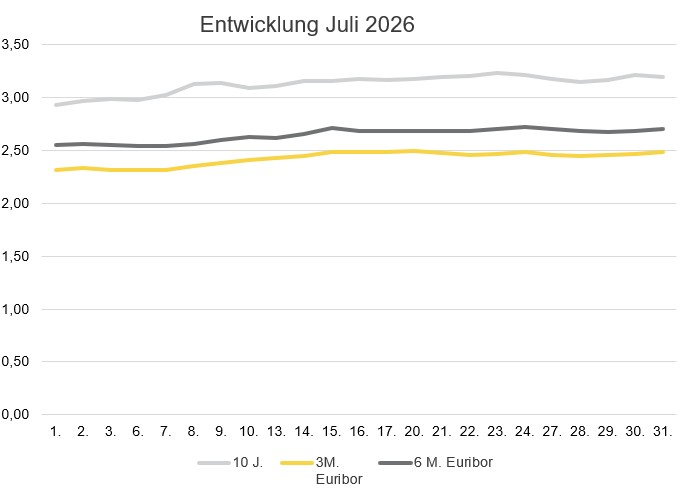
Interest rates rose in a broad upward shift across almost all maturities in July 2026. For instance, the 3-month Euribor climbed from 2.31 percent at the beginning of the month to 2.48 percent by month-end. The 6-month Euribor rose from 2.55 to 2.71 percent during the same period. This shows that the money market is increasingly pricing in not only the probability that the current prime rate level persists but also the possibility that it may tighten further.
The shift was even more evident at the long end. The 10-year swap rate increased from 2.93 percent at the start of the month to an interim level of 3.23 percent before dropping back to 3.20 percent by the end of July.
Ramifications for Real Estate Finance, and Outlook
For property developers and property asset holders, the ECB’s holding pattern brings no relief. Shorter-tenor rates have gone up, and long-tenor rates have risen yet more sharply. While it is far from certain whether interest will tighten before the end of this year, markets have come to treat such a move as a probable scenario. Accordingly, property asset holders are well advised to review their fixed long-term interest rates, assuming their cash flows and loan-to-value ratios permit doing so.